
BIM GLOSSARY
Qui di seguito le definizioni più utilizzate nel settore e un aiuto a orientarsi negli inglesismi che sono alla
base della teminologia BIM.
It is the set of all commercial, technical, and administrative activities related to a set of assets.
These activities must be considered with a view to improving financial and management performance.
The BIM Execution Plan (BEP) is the document that determines the protocol and methods for drafting, exchanging, and managing BIM model data. It defines objectives, LODs, and LOINs and may be subject to change during construction.
The BIM Execution Plan (BEP) or Information Management Plan (IMP) is an essential document, drafted to define the framework for managing the construction project and optimizing the workflow. The BEP is the result of two successive steps: the first pre-contractual, the second during the contractual execution phase.
The Italian standard UNI11337:2017 defines the same document in the Information Management Plan.
BIM Specialist takes care of modeling in the specific software adopted with subsequent extraction of the documentation.
The BIM Coordinator is responsible for the integrity of each individual model in a specialized discipline, coordinates the BIM modeler group, develops and updates BIM content, and, together with the BIM Manager, defines the activity schedule.
The BIM manager is responsible for model management processes across multiple disciplines—architecture, structure, and MEP—and for identifying interference within each discipline.
The BIM Method Statement is a useful document when collaborating with other firms and can be interpreted as a starting point for a common BIM approach to the project.
Integrated management of multiple buildings belonging to a single property, which may also have different natures and intended uses.
The CDE is the data sharing platform that must be open to all project stakeholders, thus meeting stringent interoperability and flexibility criteria for adoption by all team members.
Bentley Systems’ CDE is ProjectWise.
These are specific technical specifications that must be met during import and export between different BIM software.
These are specific technical specifications and resources that must be adopted when importing and exporting between different BIM software.
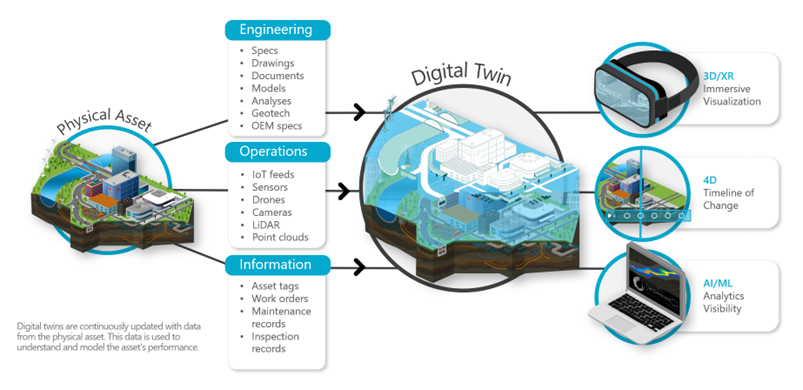
Digital Twin is obviously a Digital Twin, which means that according to this logic a physical asset must have a digital projection that is completely identical.
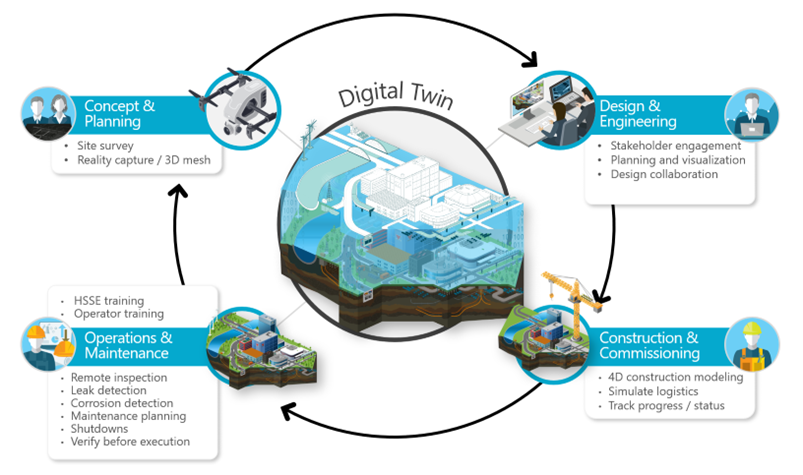
With the ability to inspect and verify everything in immersive or 4D environments for project planning, the Digital Twin thus becomes an essential tool in the safety and maintenance of buildings and infrastructure.
IFC is an open, neutral, and standard format developed by BuildingSmart, recently elevated to the status of ISO 16739:2016 standard. This type of format enables collaboration and, where appropriate, good interoperability between different project participants without requiring the use of proprietary formats (Bentley, Autodesk, etc.) and their related software.

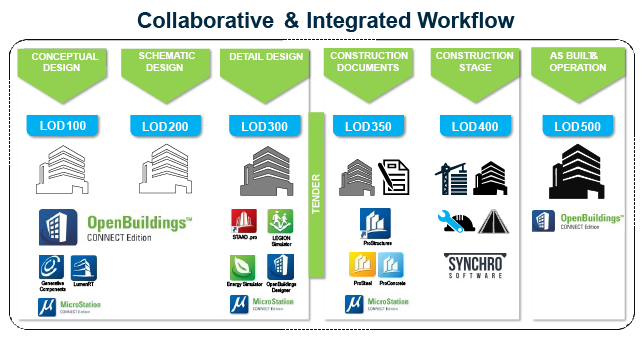
Level of development of the digital objects inserted within the project: they describe the level of detail and depth associated with BIM.
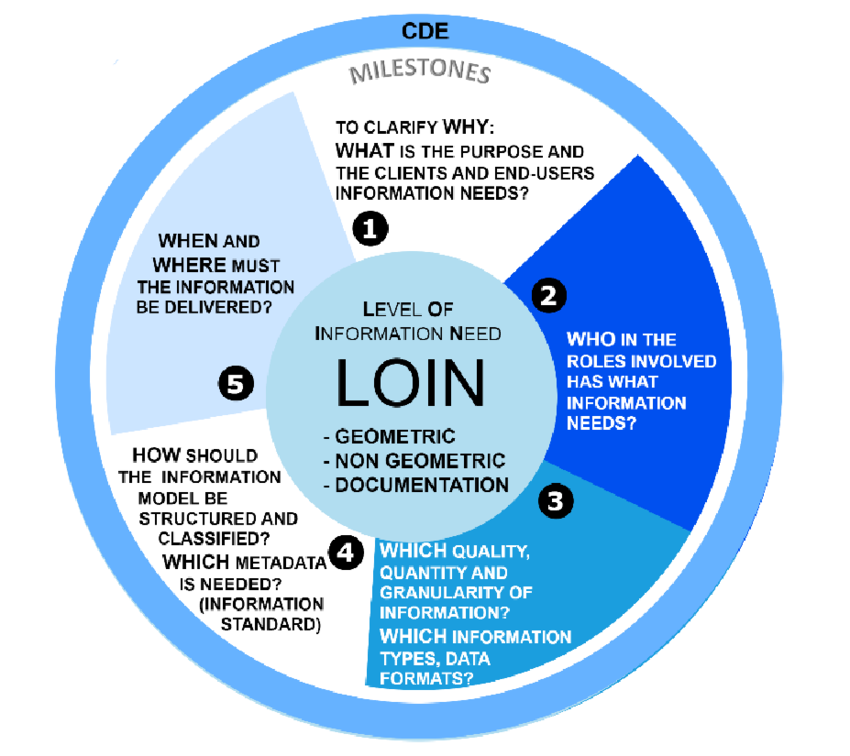
The focus in this case is no longer on the characteristics of the object but on the information the object must contain to satisfy the professional’s needs at that precise moment in the design process.
The LOIN concept stems from the understanding that the level of
depth of a model is not an absolute parameter but must be assessed based on various conditions, introducing the concept of information granularity.
e.g. A wall composed of layers but delivered in a single package is not fully readable and thus has a low granularity of information.
Conversely, a layered wall identifiable in each of its component parts will have a high granularity of information.
The level of granularity is linked to the need (Information Need), therefore it must be calibrated according to the needs, according to three categories of information:
Geometric, Alphanumeric, Documentation
This activity involves the verification and validation of BIM models. Checks are performed by automatically searching for interferences and geometric and informational inconsistencies using dedicated applications. These verification and validation operations can be performed both within the same discipline (architectural, structural, MEP, etc.) and between different disciplines
(interdisciplinary review).
All these operations are performed using Bentley iTwin Design Review.
It encompasses the multidisciplinary management of processes, such as coordinated and controlled activities carried out to achieve project objectives. The UNI ISO 21500 standard on Project Management, together with the UNI 11337 Part 8 standard, clarifies the relationship between Project Manager (Construction) and Building Information Modeling Management, a natural evolution in BIM-related design and management models.
Quantity Take Off, concerns the detailed cost analysis of all the processes involved in a project and is aimed at preparing an estimated bill of quantities.
This term refers to the set of operators, products, and services related to the real estate market. The real estate sector is commonly divided into three main segments based on the type of activities performed.
The first segment concerns the initial phase of a real estate project (r.e. development), which ranges from the feasibility assessment of the investment, to the identification of the building area, to the management of relationships with public administrations and credit institutions, up to the construction of the property.
The second category encompasses all real estate management activities (e.g., real estate management), including: ordinary and extraordinary maintenance of the property (building management); management of cleaning, concierge, internal security, and general services related to the needs of property users (facility management); and management of financial and administrative relationships, such as rent collection, insurance payments, accounting, etc., on behalf of the owner (property management).
The third segment, finally, concerns the professional management of real estate assets (asset management) aimed at enhancing and optimizing their profitability through purchase, sale, divestment, restructuring, or reconversion transactions.